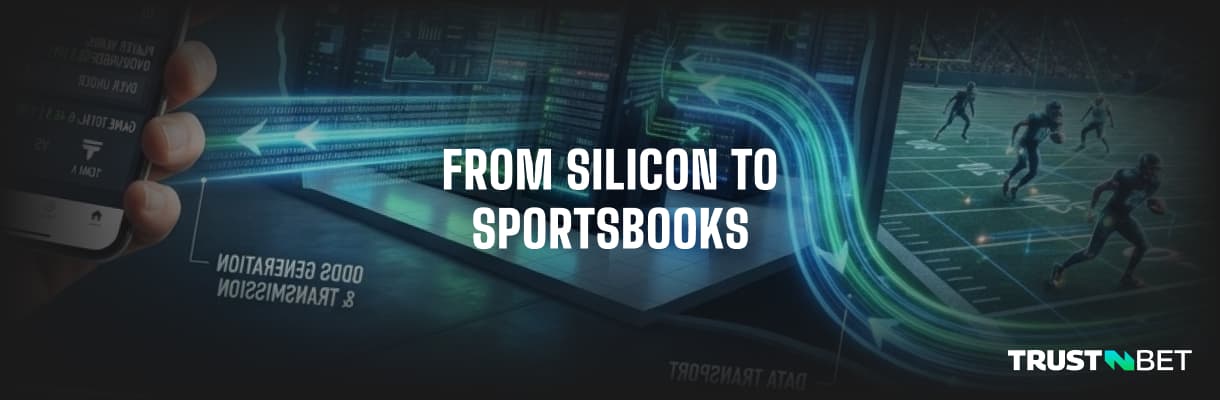
From Silicon to Sportsbooks: How Semiconductors Power Every Live Bet
When an NFL quarterback throws a touchdown pass, a sportsbook can suspend a market, update the score, recalculate hundreds of odds, and settle thousands of wagers within seconds.
To the user, it looks like an app changing a few numbers.
Behind that screen is a vast computing chain—and almost every part of it depends on semiconductors.
The modern sportsbook is not simply a website displaying betting lines. It is a real-time technology platform connecting smartphones, stadium equipment, data providers, cloud servers, payment systems, and location-verification tools.
Software controls that system, but semiconductor chips provide the computing power that allows it to operate.
Don’t miss out on more industry updates! Follow the latest gambling industry updates, from sportsbook technology and regulation to the innovations reshaping online betting.
Key Takeaways
- Semiconductor chips power sportsbook apps, servers, and data centers.
- Live betting requires extremely fast processing with minimal delay.
- Mobile chips support location verification, security, and payments.
- Stadium cameras and sensors help create the data behind live markets.
- Sportsbooks need scalable infrastructure during events such as the Super Bowl.
- More advanced chips could make betting platforms faster and more automated.
The Connection Begins Inside the Stadium
A live sportsbook market depends on information arriving quickly and accurately.
That information may begin with cameras, timing systems, broadcast equipment, player-tracking devices, or an official data operator inside the stadium. These tools contain processors, image sensors, memory chips, and communication components.
The equipment records what happens and converts the action into digital information.
A touchdown, penalty or injury can immediately affect multiple betting markets. The data must therefore travel from the venue to data providers and sportsbook trading systems with as little delay as possible.
Without semiconductor-powered cameras, networking hardware and servers, a sportsbook would receive information too slowly to offer reliable live markets.
The betting experience begins long before the odds appear on a user’s phone.
Why Live Betting Needs Powerful Chips
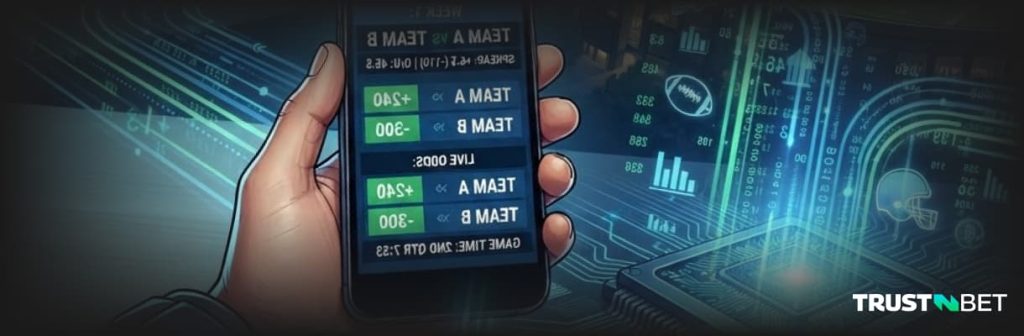
Pre-game odds may remain available for hours or days. Live odds can change several times in less than a minute.
A sportsbook must process the score, time remaining, possession, player performance, and numerous other variables. Its system then recalculates probabilities and sends updated markets to users.
The platform may also have to temporarily suspend betting when an important play begins. If the suspension arrives late, some users could wager after seeing an event that the sportsbook’s system has not yet processed.
That makes speed essential.
Modern central processing units, graphics processors, memory chips, and networking processors help servers analyze large amounts of information with extremely low latency. The faster the hardware can receive and process data, the faster the platform can react to events.
This does not mean a computer chip “predicts” the winner. It means the chip performs the calculations required by the sportsbook’s models and software.
The Super Bowl Creates a Computing Stress Test
Major sporting events can produce enormous spikes in sportsbook traffic.
Large numbers of users may log in simultaneously, check balances, compare markets, and place wagers immediately before kickoff. The same users can return during commercial breaks, halftime, or a decisive late drive.
A platform must handle all those requests without freezing or losing transaction information.
An Amazon Web Services case study on DraftKings explains that major events can generate heavy transaction activity as hundreds of thousands of users update wagers and check winnings. DraftKings reported reducing database replication delays from as much as 30 seconds to approximately 10–30 milliseconds after scaling its financial-ledger infrastructure.
That improvement is delivered through databases and cloud architecture, but the cloud is not floating somewhere above the Earth. It consists of physical data centers filled with semiconductor-powered servers, storage devices and networking equipment.
“Cloud computing” is still computing. It simply happens on someone else’s chips.
Your Phone Is Part of the Sportsbook Infrastructure
The smartphone is the final link between the sportsbook and the bettor.
Its system-on-chip runs the app, processes graphics, encrypts information, and manages communication through Wi-Fi or cellular networks. Other components support GPS, biometric authentication, and secure digital payments.
These functions are especially important in the regulated U.S. sports-betting market.
A sportsbook must verify that a customer is physically located in a jurisdiction where mobile wagering is permitted. The app may examine GPS signals, nearby Wi-Fi networks, cellular information, and other device data before accepting a wager.
Each of those processes depends on semiconductor components inside the phone.
This means the same device used to watch highlights, check an injury update, and follow a live score is also performing part of the sportsbook’s compliance work.
Chips Help Protect Accounts and Payments
Sportsbooks process financial and personal information, making security another important part of the semiconductor connection.
Modern devices use hardware-supported encryption to protect data. Secure components can help store authentication information, while processors execute systems designed to detect suspicious logins, payment fraud, and unusual account activity.
On the operator’s side, servers process deposits, withdrawals, and account balances while maintaining a record of every transaction.
These systems must be accurate as well as fast. A delayed score update is frustrating. An incorrect balance or duplicated payment is a much more serious problem.
Semiconductors quietly support both the speed users notice and the security they usually do not.
Artificial Intelligence Adds Another Layer
Sportsbooks and their technology providers are increasingly using machine learning to study large datasets.
Possible applications include detecting unusual betting patterns, managing trading risk, identifying potentially harmful customer behavior and personalizing the markets displayed inside an app.
Training and running advanced machine-learning models can require CPUs, GPUs, and specialized artificial-intelligence accelerators.
The connection between semiconductors and sportsbooks may therefore become even stronger as betting platforms introduce more automated tools.
However, faster AI does not guarantee perfect predictions. Sports remain unpredictable because models cannot fully calculate human decisions, injuries, weather changes, or a football bouncing in an unexpected direction.
Better chips can process more possibilities. They cannot remove uncertainty from sports.
What Happens When the Hardware Fails?
The semiconductor connection becomes most obvious when something stops working.
A damaged server, networking failure, or overloaded system can prevent users from logging in, delay odds updates or interrupt payment processing. If part of the stadium data chain fails, a sportsbook may suspend certain markets until reliable information returns.
Operators build backup systems to reduce those risks. Data can be distributed across multiple servers and locations so that one hardware problem does not take down the entire platform.
That resilience also depends on having enough computing capacity available when demand suddenly increases.
The biggest sportsbook technology challenge is not simply calculating odds. It is keeping every part of the system working at the same time.
The Sportsbook Industry Runs on Silicon
A sportsbook app may look like a collection of teams, numbers and buttons, but underneath it sits a physical network of chips.
Semiconductors capture action inside stadiums, move data through communications networks, calculate changing markets, verify customer locations, protect payments and display everything on a mobile device.
The sportsbook industry is therefore connected to semiconductor manufacturing more closely than most fans realize.
Every live market ultimately travels through silicon—from the camera recording the play to the processor displaying the updated odds.
The bet may be placed in seconds. The technology supporting it spans the entire digital world.
