Kalshi’s $27B World Cup Exposed Prediction Markets’ Real Business
Kalshi recorded a staggering $27 billion in trading volume during the 2026 FIFA World Cup. Roughly 3 million people used the platform during the tournament—twice the company’s internal projection.
That was not a side effect of America suddenly becoming fascinated with financial derivatives. It was sports betting demand flowing through a different legal and technological wrapper.
Prediction markets may offer contracts on elections, inflation, weather, cryptocurrency and FDA decisions. But sports remains the engine that attracts users, creates daily trading habits and generates liquidity. The industry can call these products “event contracts,” but when users are picking winners, totals and multi-leg combos, the experience looks remarkably familiar.
Stay ahead of the biggest headlines, trades and business stories shaping American sports with our latest sports news USA coverage.
Key Takeaways
- Sports has accounted for approximately 80% of Kalshi’s trading volume since July 2024.
- Kalshi generated roughly $27 billion in World Cup trading volume and attracted about 3 million users.
- Prediction-market combos closely resemble sportsbook parlays.
- The exchange model differs from a sportsbook, but the customer’s basic risk remains similar.
- Federal regulators view event contracts as derivatives, while several states consider sports contracts gambling.
- The legal classification determines age limits, state access, taxes and consumer protections.
- Sportsbooks and financial platforms are rapidly moving into each other’s territory.
Sports Is the Prediction-Market Business Model

The prediction-market pitch is much bigger than sports.
Supporters describe these platforms as tools for aggregating information, testing public expectations and producing real-time probabilities. A contract trading at 63 cents suggests the market believes an event has approximately a 63% chance of occurring.
That concept can be applied to almost anything:
- Who will win an election?
- Will inflation rise?
- Will the Federal Reserve cut interest rates?
- Will a drug receive FDA approval?
- How many hurricanes will make landfall?
- Will the Yankees beat the Red Sox?
The last question is where the volume usually arrives.
A Pew Research Center analysis found that sports represented 80% of Kalshi’s total trading volume between July 2024 and early May 2026. Sports accounted for a smaller but still substantial 39% of Polymarket’s international volume. Politics generated only 4% of Kalshi’s volume during that period.
That does not mean politics, finance, and cultural markets are irrelevant. They create headlines and give the platforms an identity that differs from traditional sportsbooks.
But sports keeps people returning every day.
The World Cup Removed Any Doubt
The 2026 FIFA World Cup became the clearest demonstration of what prediction-market customers actually want.
Kalshi reportedly expected approximately $13 billion in tournament trading volume and 1.5 million users. It finished with around $27 billion in volume and 3 million users.
That explosion was driven by familiar sports markets—not obscure hedges against economic uncertainty.
Users could trade outcomes involving:
- Match winners
- Tournament advancement
- Goals and totals
- Team and player performances
- Championship winners
- Multiple selections combined into one contract
Those products may use trading language, but they occupy the same consumer territory as moneylines, futures, props and parlays.
Prediction markets reportedly represented approximately 27% of legal U.S. sports-betting volume during the World Cup, up from an estimated 9% at the beginning of 2026. The comparison is imperfect because exchanges and sportsbooks calculate volume differently, but the direction is unmistakable.
Sports did not merely introduce people to prediction markets. It transformed them into a mainstream betting competitor.
Call It a Contract. It Still Feels Like a Bet.
The terminology is different.
A sportsbook customer places a wager. A prediction-market user buys a contract.
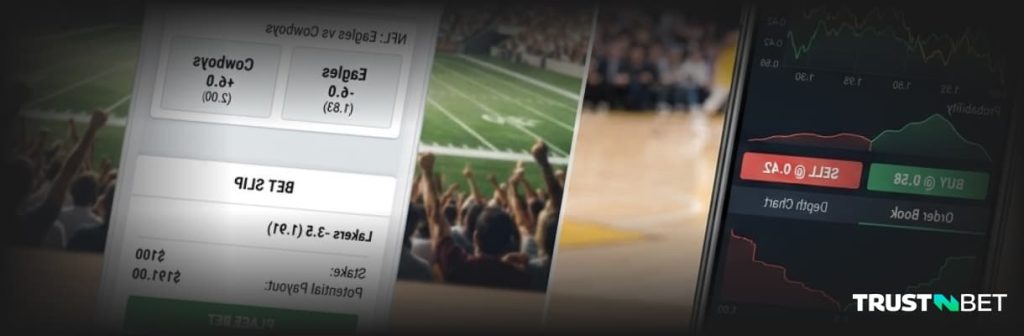
A sportsbook displays American odds. A prediction market displays a price between 1 and 99 cents.
A winning sportsbook bet generates a stated payout. A successful “Yes” contract settles at $1.
Consider a team priced at 40 cents to win:
- The customer risks 40 cents.
- The contract pays $1 if the team wins.
- The potential profit is 60 cents.
- The contract becomes worthless if the team loses.
That is effectively the same risk-and-reward decision a bettor makes when backing an underdog at approximately +150.
The interface may resemble a brokerage account, but the customer is still risking money on an uncertain sporting outcome.
Prediction Market vs. Sportsbook
| Feature | Prediction market | Traditional sportsbook |
|---|---|---|
| Product | Event contract | Sports wager |
| Pricing | Usually 1–99 cents | American or decimal odds |
| Counterparty | Other market participants | Sportsbook operator |
| Cost | Trading fees and market spread | Built-in vig or hold |
| Winning settlement | Contract generally settles at $1 | Bet pays according to listed odds |
| Early exit | User can sell the position | Cash-out may be offered |
| Primary U.S. regulator | CFTC | State or tribal gaming regulator |
| Typical minimum age | 18 | 21 in most states |
| State sportsbook taxes | Generally not applied in the same way | Paid according to state law |
| Availability | Potentially broader but legally contested | Limited to approved jurisdictions |
These differences are meaningful. Prediction markets are exchanges rather than conventional bookmakers, and users can trade in and out of positions as prices move.
But a different market structure does not automatically produce a different consumer behavior.
If someone buys a contract because they believe the Chiefs will cover, then sells it after a touchdown changes the price, that person is still making a sports prediction for profit.
Combos Make the Comparison Even Harder to Avoid
The strongest argument that prediction markets have become sportsbooks may be the rise of “combos.” Combos let users combine multiple outcomes into a single position. Each selection must occur for the contract to pay. Sportsbooks call that a parlay.
Both products offer larger potential returns by requiring several outcomes to hit. Both are exciting, easy to promote, and difficult for customers to win consistently. And both can encourage users to transform a reasonable single selection into a far more volatile multi-leg play.
Prediction markets can describe combos using contract terminology, but the underlying appeal is identical: risk a small amount for a potentially larger payout by stacking outcomes together.
Why Sports Dominates Prediction Markets
Sports offers everything a consumer prediction platform needs.
Constant Inventory
Games take place every day. Politics may generate enormous volume during an election, but major elections do not resolve every night.
The sports calendar never stops. The NFL rolls into the NBA and NHL, followed by March Madness, MLB, golf, tennis, international soccer, and another football season.
Fast Resolutions
A political or economic contract may remain open for months. A sports contract can settle within hours.
Fast settlements let users recycle their money and place another trade almost immediately.
Familiar Information
Millions of Americans already have opinions about teams, players and coaches. They do not need to understand interest-rate policy or clinical-trial data to participate.
Live Entertainment
A sports contract gives users a financial reason to watch the game. Every score, penalty, injury, and substitution changes the probability—and potentially the contract price.
Deep Liquidity
Popular games attract more buyers and sellers. Greater activity can improve pricing and make it easier for users to enter or exit positions. Sports is not simply another prediction-market category. It is the category best suited to building a daily consumer habit.
The Legal Difference Is Worth Billions
The argument over terminology is not academic. It determines who regulates the platforms, where they can operate, and which rules they must follow.
Kalshi and other federally registered exchanges argue that sports event contracts are derivatives overseen by the Commodity Futures Trading Commission. The CFTC has repeatedly asserted federal authority over regulated prediction markets and issued additional guidance covering sports-related contracts.
State regulators see the matter differently. Their argument is straightforward: if customers risk money on whether a team wins, the product is sports gambling and should follow state gaming laws.
Washington, Massachusetts, Michigan, Nevada and New York have secured court orders restricting Kalshi’s activities, while an appeals-court decision involving New Jersey supported federal regulatory authority. The competing decisions leave the national picture unsettled.
The eventual answer could affect:
- Minimum-age requirements
- State licensing
- Responsible-gambling programs
- Self-exclusion systems
- College sports restrictions
- Advertising standards
- Integrity monitoring
- State and tribal gaming revenue
- Access in states without legal sportsbooks
Prediction-market operators want one federal framework. States do not want a federal designation to erase the gambling systems they spent years building.
The Consumer-Protection Gap Cannot Be Ignored
Traditional sportsbooks operate under rules that vary by state, but those rules generally include responsible-gambling requirements, advertising restrictions, age verification and self-exclusion programs.
Prediction markets operate under financial-market regulations designed around derivatives exchanges.
That framework includes surveillance, disclosure and market-integrity obligations. However, it was not originally created to manage millions of casual sports fans making repeated game predictions from their phones.
The difference matters because the product can create the same behavioral risks as sports betting:
- Chasing losses
- Repeated deposits
- High-frequency trading
- Impulsive live positions
- Long-shot combo contracts
- Overestimating personal sports knowledge
A contract does not become harmless because its price is displayed in cents instead of American odds. The CFTC itself advises customers to understand contract rules, consider fees, and trade only with money they can afford to risk.
Prediction Markets Do Offer Real Advantages
Calling the sports side of prediction markets gambling does not mean the platforms have no value.
The exchange model can offer genuine benefits:
- Prices are created by buyers and sellers.
- Users may exit positions before settlement.
- Fees can be more transparent than sportsbook vig.
- Liquid markets can produce useful probability signals.
- A platform does not necessarily profit directly from one customer losing to the house.
- Markets can cover events that sportsbooks typically ignore.
Those distinctions make prediction markets innovative. They may also force sportsbooks to improve pricing, flexibility and transparency. But innovation should not obscure what customers are actually doing.
A user buying a contract on an election may be participating in a forecasting market. A user combining an NFL favorite, an NBA total and an MLB moneyline is making a parlay—whatever the app calls it.
Sportsbooks Are Joining the Prediction-Market Race

The clearest sign of convergence is that established sportsbooks and investing platforms now want both products.
DraftKings has launched a predictions platform containing sports categories. FanDuel has tested a standalone prediction-market product. Robinhood offers event contracts alongside stocks, options, cryptocurrency and futures.
The companies are no longer debating whether the categories will overlap. They are positioning themselves for a future in which the same customer may:
- Buy a stock
- Trade a Bitcoin contract
- Predict an election
- Back an NFL team
- Combine several game outcomes
That creates a powerful all-in-one financial entertainment product. It also makes the line between investing, forecasting, and gambling increasingly difficult for the average customer to identify.
What Happens Next?
Prediction markets are unlikely to abandon sports. The category is too large, too liquid and too effective at attracting repeat users.
The more likely outcome is a regulatory compromise or a prolonged court fight defining how sports event contracts can operate.
Platforms may eventually face:
- Higher minimum-age requirements
- State taxes or revenue-sharing agreements
- Stronger responsible-gambling controls
- Limits on college and amateur sports markets
- Restrictions involving participants and insiders
- Clearer advertising disclosures
- Greater coordination between the CFTC and state regulators
The exchanges will continue expanding into politics, finance, technology, medicine and culture. Those markets help justify the broader vision. Sports will continue paying the bills.
The Bottom Line
Prediction markets are real exchanges with structural differences from conventional sportsbooks. They can aggregate information, create transparent probabilities and let users trade positions in ways that standard betting apps cannot always match.
But the industry’s consumer boom is still overwhelmingly powered by sports. When 80% of a major platform’s trading volume comes from sports—and one soccer tournament generates $27 billion—the central product is no longer difficult to identify.
Prediction markets may be building the future of event trading. Right now, much of that future still looks, feels, and behaves like sports gambling.
