This NFL Stadium Can Seat 77% of Its Entire City
Most NFL stadiums look small when compared with the cities surrounding them.
MetLife Stadium’s 82,500 seats represent only a tiny fraction of the millions of people living around New York City. SoFi Stadium disappears into the enormous population of Greater Los Angeles. Even AT&T Stadium can accommodate only a small percentage of the Dallas-Fort Worth area.
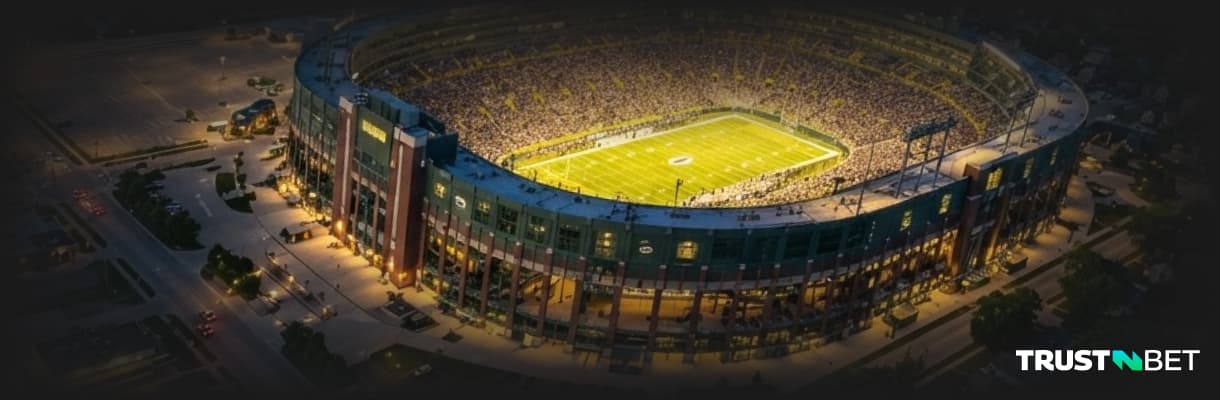
Then there is Lambeau Field. The home of the Green Bay Packers has a seating capacity of 81,441. Green Bay, Wisconsin, has a population of approximately 106,000. Put those numbers together, and Lambeau Field could seat roughly 77% of the city’s population at the same time.
That does not mean three out of every four Green Bay residents attend each game. Packers fans arrive from across Wisconsin and throughout the United States. But the comparison illustrates something extraordinary: one of the NFL’s largest and most famous stadiums is located in its smallest market.
From iconic NFL venues to the traditions and people surrounding them, explore more stories in our latest sports news USA coverage.
From iconic NFL venues to the traditions and people surrounding them, explore more stories in our latest sports news USA coverage.
From iconic NFL venues to the traditions and people surrounding them, explore more stories in our latest sports news USA coverage.
One Stadium Seat for Every 1.3 Residents
Green Bay is not simply smaller than New York, Los Angeles, or Chicago. It is smaller than dozens of American cities that have never come close to receiving an NFL franchise.
The city has roughly one Lambeau Field seat for every 1.3 residents.
If New York City maintained the same ratio, it would require a football stadium with space for more than six million people. If Los Angeles attempted it, the building would need to hold close to three million.
Those stadiums would not be stadiums. They would be cities with goalposts.
Lambeau’s size feels even more unusual because Green Bay lacks the enormous skyline and sprawling public-transit network associated with other NFL destinations. The stadium rises out of a neighborhood filled with houses, restaurants, and ordinary streets.
On game day, that neighborhood becomes the center of the football world.
The Day NFL Fans Outnumbered the City
Green Bay proved its unusual capacity for welcoming football crowds during the 2025 NFL Draft.
Approximately 125,000 people gathered around Lambeau Field on the opening day, according to Reuters.
That single-day crowd was larger than Green Bay’s population.
Across the full three-day event, reported attendance reached approximately 600,000. For one weekend, the league’s smallest market hosted a crowd almost six times the size of the city itself.
Hotels, restaurants and surrounding communities helped absorb the influx. Many visitors stayed outside Green Bay and traveled into the city, demonstrating that the Packers’ true market extends far beyond the municipal boundary.
Green Bay may be the dot on the map, but Packers territory covers much of Wisconsin.
Why the Packers Never Left
A modern NFL franchise placed in a city of 106,000 residents would appear almost impossible.
Teams generally seek large media markets, major corporate bases, luxury-suite buyers, and populations capable of filling expensive stadiums. Green Bay survives because its relationship with professional football began long before those factors controlled the league.
The Packers were founded in 1919 and joined the organization that became the NFL in 1921. They grew alongside the league rather than applying to join the finished product.
The franchise also followed a unique ownership model. Instead of belonging to one billionaire, the Packers are publicly owned by hundreds of thousands of shareholders.
The shares do not operate like conventional investments. They do not pay dividends, cannot be freely traded, and do not provide fans with a route to personal profit. Their value is primarily symbolic—but that symbolism has helped keep the franchise connected to Green Bay.
Moving the team would not simply mean changing stadiums. It would mean separating one of American sports’ strongest civic relationships.
How Lambeau Became So Large
Lambeau Field did not open with 81,441 seats.
When the stadium began hosting games in 1957, it had a capacity of approximately 32,500. Repeated expansions eventually added tens of thousands of seats, premium areas, and modern facilities without removing the venue’s traditional appearance.
The stadium is now one of the NFL’s largest by capacity, even though it serves the league’s smallest city.
That contradiction is central to Lambeau’s identity. It feels historic without being tiny and modern without resembling an indoor shopping mall.
The cold weather helps preserve the mythology. Winter games can include snow, frozen breath, and fans dressed in enough layers to qualify as upholstered furniture.
Where Is Lambeau Field?

Lambeau Field is located at 1265 Lombardi Avenue in Green Bay, Wisconsin.
The stadium sits approximately four miles from Green Bay Austin Straubel International Airport, making the airport the most direct option for visitors flying into the city.
Milwaukee is roughly 120 miles south of Green Bay, while Chicago is approximately 200 miles away. Some traveling fans fly into those larger cities and complete the journey by car.
Driving remains the most common way to reach Lambeau Field. Parking is available around the stadium, but one of the most distinctive options comes from residents. Homeowners near Lambeau frequently allow fans to park on lawns and driveways for a fee.
At most NFL venues, parking is controlled by enormous official lots. In Green Bay, a fan may leave the car in somebody’s yard and walk past neighborhood cookouts on the way to the stadium.
It is difficult to imagine a more appropriately small-town route into a major professional sporting event.
The NFL’s Biggest Small-Town Experience
Lambeau Field’s appeal is not based only on championships or history.
It comes from scale. The stadium is enormous, but the city feels personal. The Packers are a global sports brand, but their home is surrounded by residential streets. Tens of thousands of people arrive for an NFL game, yet the experience can still feel like the entire community has gathered in one place.
In a league increasingly dominated by billion-dollar indoor venues and entertainment districts, Green Bay remains the exception.
It is the NFL city small enough to fit inside the imagination—and the city whose stadium could hold nearly everyone who lives there.
