
NBA 2026: Blind Fans Can Now Feel Every Pass and Shot
For most basketball fans, following the ball is automatic. They watch it leave a player’s fingertips, travel across the court, and drop through the net.
For fans who are blind or have low vision, that experience has traditionally depended on radio commentary, arena announcements, or explanations from someone sitting nearby.
New technology being offered at Phoenix Suns home games is changing that. Instead of asking fans to imagine where the ball is, it allows them to feel its movement beneath their fingertips in real time.
It is called OneCourt—and it may represent one of the most meaningful sports-technology developments of the NBA 2026–27 season.
Discover the technology, personalities, and unforgettable moments reshaping the games in our latest U.S. sports stories.
Key Takeaways
- OneCourt converts live NBA game data into physical vibrations.
- Blind and low-vision fans can track the ball using a tablet-sized tactile court.
- Optional audio provides additional information about important plays.
- The Phoenix Suns offer the devices to fans at no additional cost.
- The technology is already expanding across several U.S. sports and arenas.
How Can Someone Feel a Basketball Game?
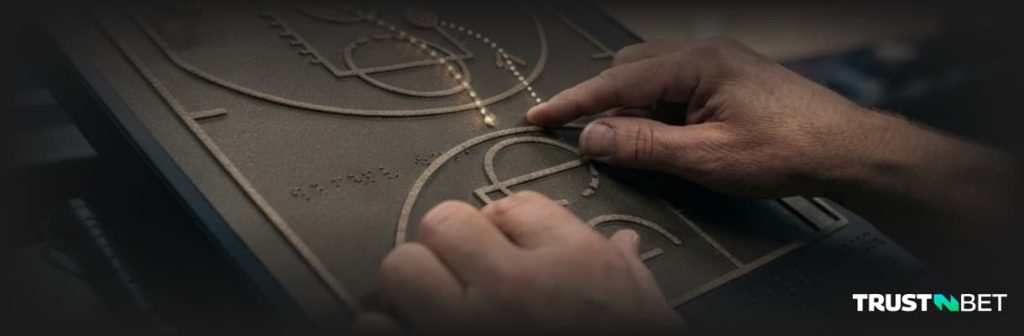
The OneCourt device resembles a small basketball court that can rest on a fan’s lap.
Its surface includes a raised outline of the playing area. When the ball moves across the real court, vibrations move across the device in the same direction. Fans place their hands on the surface and follow the action through touch.
A possession that starts in the backcourt moves toward the basket. Passes, shots, and changes of possession create different patterns, helping the user understand what is happening without needing to see the floor.
The device can also produce short audio updates through connected headphones, adding information that may not be easy to communicate through vibration alone.
The Phoenix Suns’ official OneCourt page explains that the technology converts live NBA gameplay data into trackable vibrations and audio, allowing fans to follow each play with their fingertips.
More Than an Alternative Broadcast
Sports broadcasts have added countless visual features over the years.
Television viewers receive instant replays, shot charts, player-tracking graphics, and advanced statistics. Fans inside arenas watch giant screens filled with highlights and real-time data.
Most of those innovations assume the audience can see them.
OneCourt begins with a different question: What if the information were translated into touch?
That distinction matters. The device is not merely describing what already happened. It is trying to place the user inside the live rhythm of the game.
A blind fan does not have to wait for another person to explain that the ball has moved to the corner or that a fast break is developing. The movement can be followed as it happens.
That independence may be the technology’s greatest achievement.
Why Live Sports Can Be Difficult to Follow
Basketball moves quickly, even for viewers with full vision.
Ten players constantly change position. The ball can travel from one end of the court to the other within seconds. A missed shot can become a rebound, outlet pass, and fast-break dunk before an announcer finishes describing the first attempt.
Traditional play-by-play commentary helps, but it must prioritize certain details. An announcer may describe the scorer without explaining where every player moved or how the play developed.
Inside an arena, crowd noise can make audio even harder to follow.
A tactile display supplies another layer of information. Rather than replacing commentary, it works alongside it. Touch communicates the ball’s location and movement, while audio can explain fouls, scores, and other key events.
Together, those signals create a fuller picture of the game.
The Suns Are Part of a Growing Movement
Phoenix is not the only NBA market experimenting with tactile sports broadcasts.
OneCourt technology has appeared with teams including the Portland Trail Blazers, Brooklyn Nets, Sacramento Kings, Atlanta Hawks and Orlando Magic. The concept has also moved beyond basketball, with versions designed for baseball, football and soccer.
That flexibility comes from the underlying idea. The technology does not need to recreate every visual detail inside a stadium. It needs live tracking data and a tactile layout that matches the sport.
For basketball, the surface resembles a court. For baseball, it can represent the diamond. A football version can track the ball’s movement along the field.
As professional leagues collect more accurate real-time data, the potential applications become much broader.
Accessibility That Does Not Separate the Fan
One of the most important aspects of the program is where it is used.
Fans do not need to enter a separate room or watch a delayed version of the game. The device can be carried to their seat, allowing them to experience the action alongside friends, relatives and thousands of other supporters.
That shared experience is central to live sports.
Attending a game is not only about understanding the score. It is about reacting with the crowd, feeling the building grow louder and celebrating at the same moment as everyone else.
If technology provides information several seconds late, that connection can disappear. A fan may still learn what happened, but the emotional moment has already passed.
Real-time tactile feedback helps close that gap.
Could This Become Standard in U.S. Arenas?
The technology remains relatively new, and access currently depends on the participating team and number of available devices.
That means availability may be limited, particularly for high-demand games. Fans may need to contact arena guest services in advance rather than assume a device will be waiting when they arrive.
But the long-term possibilities are significant.
Closed captioning, wheelchair-accessible seating and audio description are now recognized as essential parts of making sports available to wider audiences. Tactile broadcasts could eventually become another standard arena service.
Teams spend millions upgrading scoreboards, premium seating and concession areas. Compared with those projects, providing tactile devices is a relatively focused change—yet it could completely transform the experience for some fans.

Technology That Makes the Crowd Bigger
Much of the conversation around sports technology focuses on improving performance, officiating or revenue.
OneCourt serves a different purpose.
It does not help a player shoot more accurately. It does not determine whether a referee made the correct call. It helps more people experience the game independently.
That may not produce the loudest technology headline, but it could create the most human impact.
For blind and low-vision fans in Phoenix, basketball is no longer something that must be reconstructed entirely through someone else’s words.
Every pass has a direction. Every possession has movement. Every shot can now be felt.
