
The $Billion Tech System That Could End Bad Calls in Baseball
Something strange happened before the 2026 baseball season. Players across Major League Baseball started… shrinking.
Not metaphorically—literally.
Some lost two inches. Others lost three. A few, like Shohei Ohtani, somehow got taller overnight.
But this wasn’t a mistake. And it definitely wasn’t cosmetic. It was the result of one of the most precise measurement protocols ever introduced in professional sports—designed for a system that could fundamentally change baseball forever.
✅ Key Takeaways
- Precision Matters: MLB now measures every player down to the millimeter to define personalized strike zones.
- Challenge-Based System: ABS doesn’t replace umpires but allows players to challenge calls, resolved in 10–15 seconds using 12 cameras and 5G.
- Personalized Strike Zones: Zones are based on player height, shrinking most hitters’ zones by ~2 inches.
- Minimal Game Delay: Average challenges add only about 1 minute per game, barely offsetting pitch clock savings.
- Strategic Opportunities: Pitchers, hitters, and catchers can exploit ABS nuances, creating new layers of in-game strategy.
- Human + Machine Hybrid: MLB keeps umpires in the game while enhancing accuracy, avoiding fully automated “robot umpire” pitfalls.
- A New Era for Baseball: ABS signals a broader trend of technology shaping sports, combining tradition with data-driven precision.
Why MLB Is Measuring Players Like This

Before the 2026 season, MLB required every player to go through a strict height verification process:
- No shoes
- No hats
- Back flat against the wall
- Knees exposed for accuracy
- Measurements taken between 10 a.m. and 12 p.m.
Even the timing mattered. Why? Because the human spine compresses throughout the day, your height can slightly decrease by evening. That level of precision might seem excessive—until you understand what it’s for.
👉 MLB’s new Automated Ball-Strike (ABS) system depends on exact player height down to the millimeter.
⚾ The End of Guesswork in Baseball
For more than 150 years, baseball has relied on human judgment to call balls and strikes.
That meant:
- Inconsistency
- Arguments
- Game-changing mistakes
Now, MLB is introducing a system where calls can be:
- Challenged
- Verified by machines
- Displayed instantly to fans
This isn’t just a rule change. It’s the first time in baseball history that the strike zone is being defined by data instead of perception.
🎥 The 12-Camera System Watching Every Pitch

At the core of ABS is Hawk-Eye technology, the same system used in tennis and soccer.
Each MLB stadium already has:
- 12 high-resolution cameras
- 5 focused specifically on pitch tracking
- 7 tracking player and ball movement across the field
These cameras work together using triangulation:
- Multiple angles track the same pitch
- Data is combined into a precise 3D trajectory
- Accuracy reaches within fractions of an inch
This means the system doesn’t estimate—it calculates.
How 5G Makes Instant Decisions Possible
Accuracy is only useful if it’s fast. That’s where 5G comes in. MLB partnered with T-Mobile to build private 5G networks inside stadiums.
Here’s what happens during a challenge:
- Cameras capture the pitch
- Data is processed instantly
- The result is sent to the umpire and scoreboard
- Fans see the replay in real time
All within about 10–15 seconds. No long delays. No confusion. Just a clear answer.
The Strike Zone Is Now Personalized
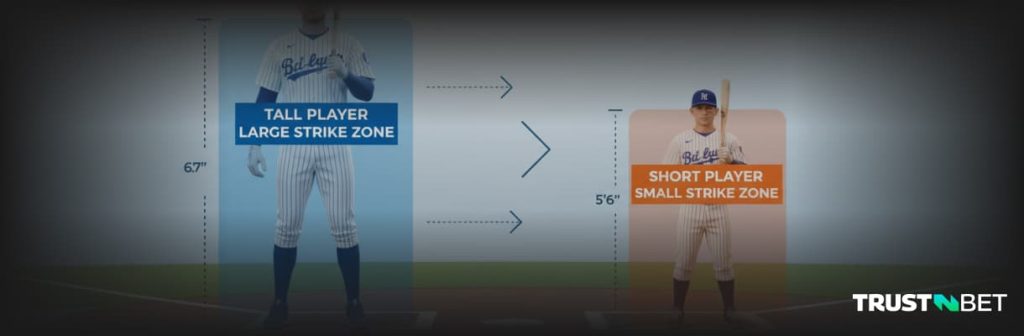
This is where things get really interesting. Instead of a one-size-fits-all strike zone, ABS creates a custom zone for every player.
It’s based entirely on height:
- Top of zone = 53.5% of height
- Bottom = 27%
That means:
- Taller players = bigger zones
- Shorter players = smaller zones
For example:
- A tall hitter like Aaron Judge gets a significantly larger vertical zone
- A shorter player like José Altuve gets a tighter one
And here’s the twist: Studies show the new system actually shrinks the strike zone for most players by about 2 inches
The System Isn’t Perfect
Even with all this technology, ABS has limitations.
1. It’s Not Fully 3D
The system evaluates the ball at a single point—the center of the plate.
So:
- A pitch that clips the front edge but moves out later
- Might be called differently than a human umpire would
2. It Ignores Batting Stance
The system uses height, not how a player is actually standing.
That means:
- A crouched hitter doesn’t get a lower zone
- A tall, upright stance doesn’t raise it
This could create subtle mismatches between visual perception and machine judgment.
How the Challenge System Works

MLB chose a challenge-based system, not full automation.
Here’s how it works:
- Each team gets 2 challenges
- Only the pitcher, catcher, or batter can challenge
- Must be done within seconds
- Successful challenges are kept
This adds a strategic element:
- Do you challenge early?
- Save it for late-game pressure?
It’s baseball’s version of a high-stakes gamble.
What 7 Years of Testing Revealed
This system wasn’t rushed—it’s been tested since 2019.
Key findings:
- Only about 1% of pitches are challenged
- Games average 4–5 challenges total
- Each challenge takes ~14 seconds
- Total added time per game: ~1 minute
That’s important because: The pitch clock reduced game time by ~30 minutes
So ABS barely slows things down.
When Do Players Challenge?
Data shows something fascinating:
- Early innings → fewer challenges
- Late innings → more aggressive challenges
But here’s the twist:
👉 Early challenges are more successful
Why? Because players avoid risking challenges on borderline calls early—but become more desperate later.
Who Benefits the Most?
The ABS system creates winners and losers.
Hitters:
- Smaller strike zones → more walks
- Fewer borderline strike calls
Pitchers:
- Must be more precise
- Can’t rely on umpire tendencies
Catchers:
- Pitch framing becomes less valuable
- But still matters ~97% of the time
Unique Advantage:
Players who understand the system best may gain a strategic edge in challenges
Why MLB Didn’t Go Full “Robot Umpire”
MLB tested fully automated strike zones—and rejected them. Why?
Because they:
- Increased strikeouts
- Changed gameplay too much
- Removed key skills like framing
So MLB chose a middle ground: Human umpires + machine verification
Even the umpires’ union agreed—because it preserved their role.

The Bigger Shift Happening in Sports
This isn’t just about baseball.
It’s part of a larger trend:
- Technology replacing judgment
- Data replacing instinct
- Precision replacing tradition
From tennis line calls to soccer offsides, sports are becoming more measurable than ever.
Baseball is just catching up.
Final Takeaway
MLB’s ABS isn’t about eliminating mistakes. It’s about reducing the ones that matter most—without breaking the rhythm of the game.
With:
- Millimeter-level player measurements
- 12-camera tracking systems
- Real-time 5G processing
Baseball is entering a new era where every pitch can be verified, challenged, and understood. And whether fans love it or hate it…The strike zone is no longer a judgment call. It’s a calculation.
Don’t miss what’s happening across American sports—get the latest sports news U.S.A and game-changing updates delivered straight to you.
