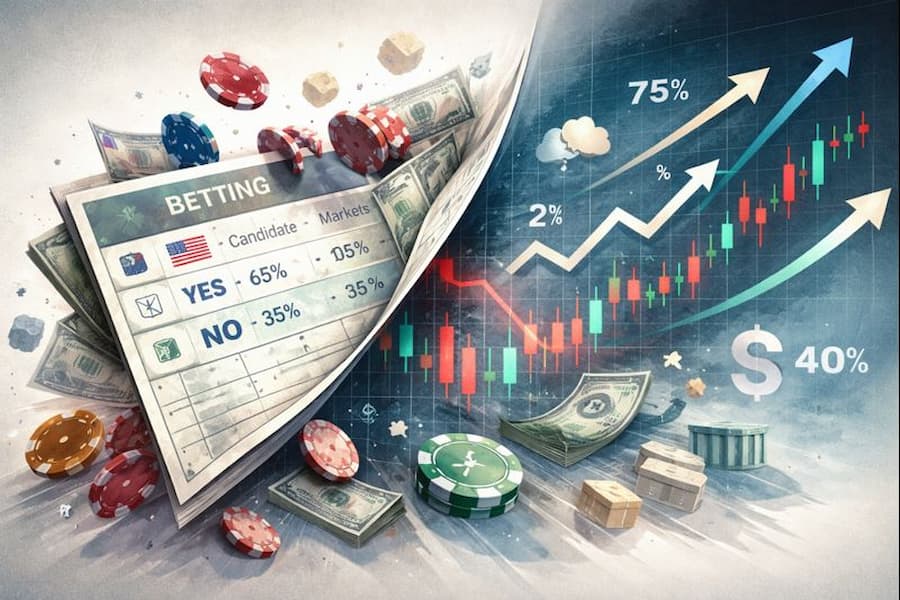
The Uncomfortable Truth About Prediction Markets
There’s a strange double standard in how Americans talk about prediction markets. When someone bets on a football game, we call it gambling. When someone wagers on an election outcome, inflation data, or a Supreme Court ruling—suddenly it’s “forecasting.”
Same mechanics. Same incentives. Different vocabulary. Prediction markets are gambling. Not in a philosophical sense. Not as a metaphor. In the most literal, everyday meaning of the word.
- You put money down on an uncertain future event.
- You win if you’re right.
- You lose if you’re wrong.
That’s it. Everything else is a costume. The more prediction markets expand into politics, finance, and media, the harder it becomes to maintain the polite fiction that they’re something else. And the reason that fiction exists in the first place tells us a lot about how Americans feel about gambling, power, and trust.
What Prediction Markets Actually Do
Prediction markets allow users to buy and sell contracts tied to future outcomes.
- Will a candidate win an election?
- Will interest rates rise this year?
- Will a company miss earnings?
- Will a war escalate or de-escalate?
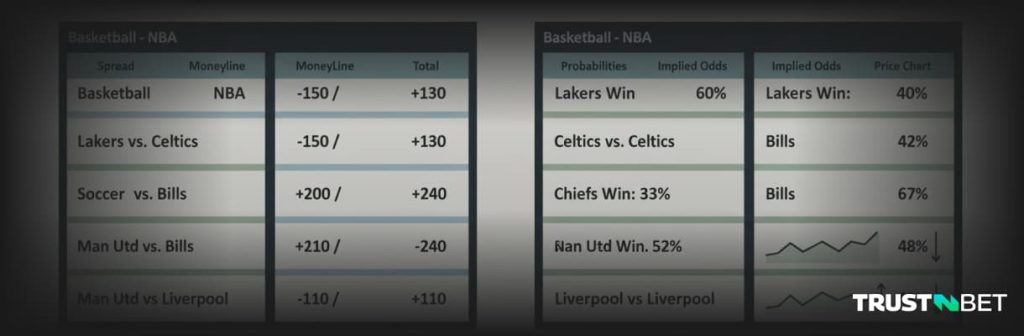
Each outcome has a price, usually expressed as a probability. If the event happens, the contract pays out. If it doesn’t, the contract expires worthless. This is not meaningfully different from betting odds.
Whether the wager is framed as a “YES” or “NO” contract, a probability percentage, or a dollar amount doesn’t change the underlying reality. Participants are risking money on uncertainty in hopes of profit. That’s gambling.
It doesn’t matter that participants may be informed, analytical, or statistically savvy. Poker players are skilled, too. So are sports bettors who build models. Intelligence doesn’t change the category of activity—it just changes who wins.
Why the Language Games Exist
If prediction markets are so obviously gambling, why does everyone involved work so hard to avoid saying so? Because “gambling” comes with baggage.
In the United States, gambling is heavily regulated, politically sensitive, and morally complicated. It raises concerns about addiction, exploitation, fairness, and social harm. It triggers state-by-state laws, consumer protections, advertising limits, and public scrutiny. “Forecasting tools” don’t.
So prediction markets borrow the language of economics and data science:
- “Information aggregation”
- “Market-based signals”
- “Wisdom of crowds”
- “Decision support”
None of this is false. Markets do aggregate beliefs. Prices do encode information. Betting odds do reflect collective expectations. But none of that makes the activity non-gambling.
Sportsbooks also aggregate information. So do horse racing odds. So does Vegas. Accuracy and gambling are not opposites—they often go hand in hand. The rebranding isn’t about truth. It’s about legitimacy.
The American Discomfort Factor
Prediction markets feel different to Americans than traditional gambling, and not just because of the subject matter. Betting on sports feels contained. It happens in casinos, apps, or designated platforms. There’s a cultural understanding of where it belongs.
Prediction markets bleed into everything else. They appear next to news headlines. They sit alongside financial dashboards. They intersect with elections, wars, disasters, and public policy. They turn collective anxiety into tradable assets.
That makes people uneasy—and for good reason. When people bet on elections, they’re not just predicting outcomes. They’re financially incentivized to want certain futures. That doesn’t mean they cause those outcomes, but it does change how information is consumed and shared.
Markets shape narratives. Narratives shape behavior. Behavior shapes outcomes. Pretending this is just neutral forecasting ignores how incentives actually work.

Accuracy Doesn’t Change the Moral Category
Defenders of prediction markets often point to their track record.
- They’re more accurate than polls, we’re told.
- They outperform pundits.
- They react faster to new information.
All of that may be true. But accuracy has never been what separates gambling from something else.
Bookmakers are famously accurate. Odds-makers often outperform analysts, commentators, and “experts.” No one concludes from this that sportsbooks are academic institutions.
In fact, accuracy is what makes gambling markets compelling. If betting markets were consistently wrong, they wouldn’t attract participants. So yes—prediction markets can produce useful signals. That doesn’t make them non-gambling. It just means they’re good at it.
Regulation Is the Real Issue
The distinction between gambling and “prediction” matters most when regulation enters the picture.
In the U.S., sports betting is regulated primarily at the state level. Platforms must follow strict rules around licensing, consumer protections, advertising, and disclosures. Some states allow it; others don’t. Prediction markets, by contrast, often operate under federal oversight frameworks originally designed for commodities and derivatives—not mass-market gambling products.
This creates a strange situation:
- Prediction markets are accessible nationwide
- They operate continuously
- They cover an enormous range of events
- They face fewer guardrails than sportsbooks
Functionally, they can look like sportsbooks without the same constraints. That’s not a loophole accident. It’s the result of insisting these platforms aren’t gambling—even when they behave exactly like it.
When Everything Becomes a Market
There’s a deeper cultural issue underneath all of this. Prediction markets reflect a broader trend in American life: the financialization of everything.
- Attention became monetized.
- Social interaction became platforms.
- Risk became tradable.
- Now, uncertainty itself is a product.
When every future outcome has a price, every event becomes an opportunity to speculate. Elections become assets. Disasters become volatility. Public trust becomes liquidity. This doesn’t automatically make prediction markets evil. But it does make them powerful—and power without clear rules tends to distort behavior.
The question isn’t whether people should be allowed to bet on the future. People already do, constantly, in all kinds of ways. The question is whether we’re being honest about what we’re building.
The Cost of Pretending
Calling prediction markets “forecasting tools” instead of gambling platforms has consequences.
It:
- Confuses users about risks
- Weakens consumer protections
- Blurs ethical boundaries
- Undermines trust when things go wrong
In traditional finance, insider trading is restricted not because information should be hidden, but because markets collapse when participants believe the game is rigged. Gambling markets already assume asymmetry. Some players know more. Some are better. That’s part of the deal.
But pretending a gambling market is something else raises expectations it can’t meet. When people think they’re consuming neutral information rather than participating in a betting ecosystem, the relationship breaks down.
Call It What It Is
Prediction markets don’t need to be banned to be understood clearly. They don’t need to be moralized into oblivion. They don’t need to be elevated into oracle machines either. They need honesty.
They are gambling platforms that:
- Aggregate beliefs
- Produce signals
- Create incentives
- Operate in socially sensitive spaces
Once we accept that, the conversation becomes simpler and more productive. We can debate where they belong, how they should be regulated, and what limits make sense—without hiding behind euphemisms.
The problem isn’t that people are betting on the future. The problem is that we keep pretending they aren’t. And everyone already knows better.
From coast to coast, we’ve got you covered! Follow all the big updates and exclusive sports news across America.
