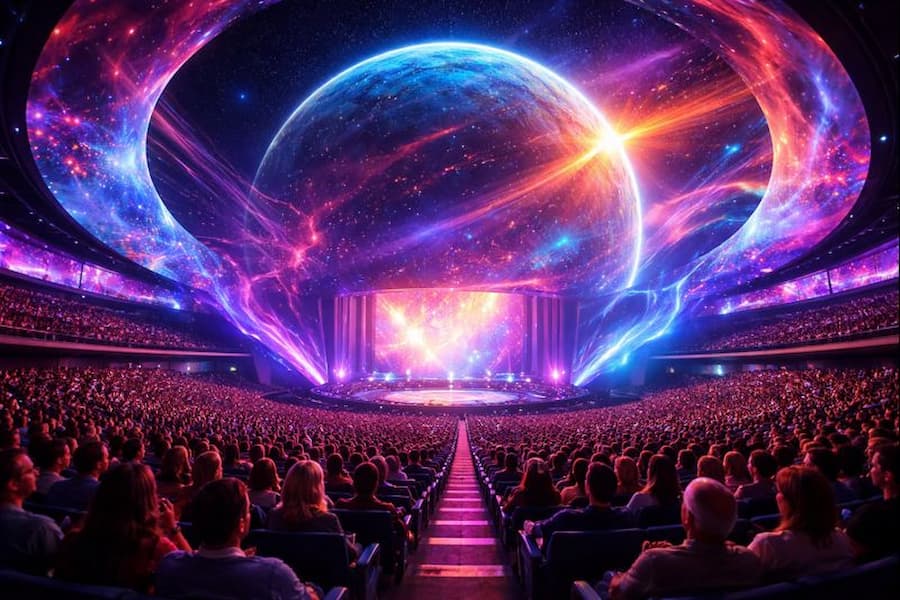
Why Sphere Entertainment Is Going Smaller to Make Bigger Profits
The $2.3 billion Las Vegas Sphere was a headline grabber — but not always for the right reasons. Early losses and sky-high construction costs made some skeptics call it a flop.
Now, Sphere Entertainment is flipping the script. The company announced a new venue in National Harbor, just outside Washington, D.C., that will seat 6,000 people — far smaller than Las Vegas’s 17,600.
The move shows a clear strategy: smaller, smarter venues that reduce risk while still delivering big profits and unforgettable experiences.
Key Takeaways
- Smaller Venues = Lower Risk: Less construction and operational costs make each location safer financially.
- Easier to Fill Seats: Smaller venues sell out faster, boosting demand and excitement.
- Content Goes Further: Productions like The Wizard of Oz can tour multiple cities, keeping costs low and revenue high.
- Better Fan Experience: Intimate settings make immersive shows more memorable.
- Scalable Expansion: More cities can support 6,000-seat venues than multi-billion-dollar mega-Spheres.
Why Smaller Venues Make Sense
The Las Vegas Sphere showed the challenges of mega-builds: massive upfront investment, high fixed costs, and long timelines before turning a profit.
Smaller venues solve many of these issues:
- Lower Costs: National Harbor’s $1 billion build is far cheaper than Las Vegas’s $2.3 billion.
- Easier to Fill: 6,000 seats are much easier to sell out than 17,000+.
- Flexible Operations: Staffing, insurance, and maintenance are more manageable.
The result? Sphere can replicate its immersive experiences across multiple cities without taking on the financial risks of a multi-billion-dollar build.
Making Content Work Harder
Productions like Sphere’s $100 million Wizard of Oz adaptation are expensive upfront, but smaller venues allow the company to stretch that content further:
- Shows can tour multiple cities with minimal extra cost.
- Artists can perform mini-residencies instead of full tours, saving production dollars.
- Frequent showings maximize venue usage and revenue.
The formula is simple: invest big once, then make it pay off many times over.
Fans and Cities Win Too
Smaller venues aren’t just good for the bottom line — they improve the experience for everyone involved:
- Closer and More Immersive: Fans are literally closer to the action.
- More Events, More Excitement: Smaller venues make frequent shows possible.
- Community Impact: National Harbor alone is expected to create 4,750 jobs and generate more than $1 billion in annual economic activity.

Local governments are also more likely to approve smaller venues because the cost and impact are more manageable.
Scaling Globally
The Las Vegas Sphere was a bold experiment. Smaller venues are the repeatable model.
- More cities can economically support 6,000-seat venues than 17,000-seat mega-arenas.
- Standardized “Sphere-ready” productions make touring simpler.
- Corporate events and immersive shows fit neatly into a predictable, profitable framework.
By going smaller, Sphere is building a network of fan-friendly, high-margin venues that can grow globally without extreme capital risk.

Conclusion: Smarter, Not Bigger
Sphere Entertainment’s pivot from mega-arenas to smaller venues proves a simple truth: bigger profits don’t require bigger buildings.
Lower costs, higher utilization, and memorable fan experiences make this a strategy worth watching. National Harbor will be the first test — and if it works, it could reshape how live entertainment is built, sold, and experienced across the U.S.
Catch Every Big Moment in Sports News U.S.A — Breaking Stories, Epic Highlights, and All the Action You Can’t Miss!
